
“The limits of tyrants are prescribed by the endurance of those whom they oppress.” – Frederick Douglas.
DAOs are a great and novel way for virtual communities to get together and use a common treasury to fund and fulfil their common goals.
I had the pleasure of joining many DAOs and did learn and applied my knowledge to understand better if we can coordinate at scale without central authority managing the community.
Some DAOs had a fantastic culture, talent, and workflow and had an iterative process of improving their governance; others looked, smelt and sounded like DAO. After some time, I realised it was not a DAO but a CAO.
What is a CAO?
CAO (pronounced “cow”) phonetics:[ k ow ] stands for “Central Apprehensive Organization”. A CAO looks and feels like a DAO, but if you take a closer look at the intangible features that will soon be revealed, you will notice the difference.
The basic anatomy of a CAO looks like a DAO but reveals itself under an X-ray.
Anatomy of a CAO
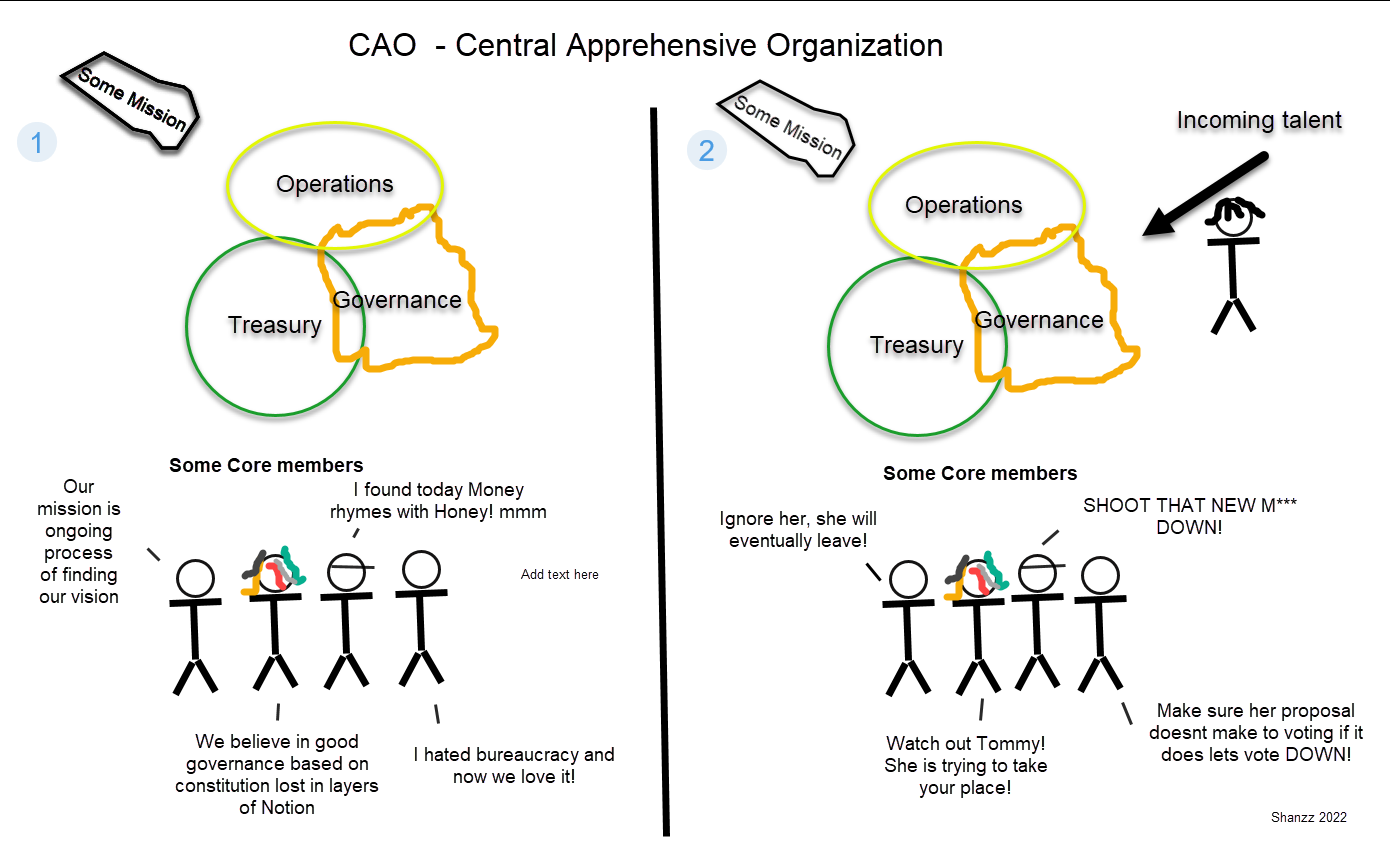
There are a few elements that make up the CAO, first is usually a treasury that mostly pays a full-time salary; second, a non-existent framework/shadow of governance/lack of transparency; third is bad culture; and fourth is FEAR.
Fear what?
Well, if you look at the diagram with some core members clinging to the treasury. Their primary fear is nouveau talent. The new talent scares them, and they wet the bed sheets like they’ve had a nightmare of White Walkers in Chewbecca’s Halloween costumes.
Why do they fear new talent?
A capable member can pose a threat to the jobs of existing people as they can go out of their way to do quality work or question the meaning of members’ work which could potentially increase peer pressure on some members who have been slacking. An experienced DAO member can pose an even bigger problem by asking questions that look at the big picture.
“What is the mission of the DAO?”
“How does your work fit into your vision for the DAO?”
“Who controls the Treasury?” Why is the control at the hands of few people?”
All the above questions can rile “top” members of a CAO.
So how do you identify a CAO? If the DAO is more than six-eight months old, then follow the below steps (add up the possibilities to increase chances of discovery):-
1, Controlled Treasury
Check if there is usually a Treasury paying full-time salary with the control that wrests with a few people progressively decentralising forever like Nietzche’s Eternal World.
Verdict: 20% chance of being CAO
2, Shadow mission & governance
They may have a template of control, Bylaws, Charter, and governance procedures. Still, it does not have clarity, or they don’t bother following it and follow the whims of a few people who centrally govern it. The members high up in the hierarchy mention vague rules that are not there in their governance document “We have people who select members (no criteria)” and “Our guys in the top rejected the work (based on what?).”
Verdict: 40% chance of being CAO
“In questions of power, let no more be heard of confidence in man, but bind him down from mischief by the chains of the constitution.” – Thomas Jefferson.
3,Body of Rights/By-laws/Constitution/Charter
Their Body of Rights/By-laws/Constitution/Charter that provides the framework of governance is not present or followed. If you find the Constitution hidden somewhere in Notion written in language that requires summoning oracles from the legalese world to decipher and no clear mission statement from where goals are derived. In that case, there is a possibility you have stumbled into a CAO. Or a DAO that will soon slip into the chaos of CAO.
Verdict: 30% chance of being CAO
4 Voting power
The voting power (if there is any voting) rests on a few select people without clear succession plans to decentralise. There are some DAOs where a few members own majority tokens to shoot down a proposal or prevent a proposal from going to vote. If a DAO has existed for more than eight months with no plans to progressively decentralise, it may be a CAO.
Possibility: 50% chance of being CAO
5, Vague Roles & Responsibilities
In any self-governing organisation, it is essential to establish clear roles and responsibilities to manage expectations. If this is not done, it could result in members not completing work or doing redundant work, which would be a waste of resources. Additionally, suppose members are dissatisfied with their work because it does not meet “standards” that were not provided. In that case, this could cause members to become antagonistic towards the organisation. There should also be a governance process to change any responsibilities.
Check if the roles and responsibilities are mentioned in a document and if the bounty has mentioned tasks and responsibilities. If you don’t find any, then it may be a CAO.
Possibility: 35% chance of being CAO
6, Recruit Talent
Check their acceptance of new skilled members.
A litmus test determines if a DAO is ready to accept new talent.
a, Go to their discord and post your best work can be the article you have written, like “DAO is the next best thing since Jack Black and Jack White formed a Rock band” or “transitional NFT”, showing Vitalik reaching complete puberty.
Make sure you write an intro “ I have written/ made this…..
Post in the discord channel where articles are shared or post in the general chat section, wait and watch.
If it is a high-traffic guild, identify the guild leaders, tag them, and ask their opinion.
b, Go to their community weekly or monthly guild or DAO meetings and throw them BIG questions if there are leaders present.
For example:
What motivates guild members to wake up at night and work for the DAO?
What would the world look like if your DAO achieved its mission?
Can we see your financial audit statements to check the transparency?
Do you have an onboarding system to recruit new members? Do you elect members of the organisation?
After doing (a) and (b), check if they:-
Do they take time to read and analyse your work?
Do they actively try to recruit you to join their guild?
Do they pitch the positives of joining their DAO?
Do they gladly answer your questions regarding governance, operations, onboarding and meme generation?
Try out 2-3 of their guilds; if they do not invite or pitch you, you most probably have stumbled into a CAO.
Possibility: 55% chance of being CAO
6, Voting activity
Go to the proposals, look at the number of core members who almost work full time and check how many actively participate in bids and decision-making. If less than 25% of core members actively participate in the decision-making process in their respective guilds or pods, you may have stumbled into an unengaging DAO.
Possibility: 55% chance of being CAO
“Culture is simply a shared way of doing something with a passion.” – Brian Chesky
7, Culture
This is a DAO’s most crucial intangible component.
Culture, in my opinion, is the set of values, ethics, beliefs, attitudes, and behaviours of the DAO community that serves as the glue that holds the community together and inspires selfless members to loyalty and dedication to the success of the DAO. A DAO with great culture acts like an invisible black hole that attracts talent to join the mission, invigorates members and keeps them engaged to collectively strive for something beyond individual goals.
There is no complex answer to whether or not a DAO has a good or bad culture. However, a lack of transparency, openness, and honesty often indicates bad culture. Additionally, groupism and passiveness among members can show a negative culture, as these behaviours prevent individuals from taking the initiative and speaking up.
If you are new to the group, the best way to gauge DAO culture quickly is to check the proposals page. How open are members to criticism of their ideas? How do they resolve tension and differences? Do you see a trend where one group always agrees or supports one person?
You will find differences in every DAO. If you don’t, you are either in a homogeneous group of people who think the same way or with a bunch of sycophants. The best way is to notice how they resolve their differences.
Do they shoot down the messenger and move from the message?
How open are the members to radical ideas that can make their jobs redundant?
When reading criticisms, do you feel they have hidden animosity they are bringing up?
If yes, then it is time to dig deeper.
Dig through the proposals archive and check which members were engaged. Message the ones (8 to 10 members) that stopped engaging the DAO and find out why?
If the majority say they disagreed with policy changes that changed the power structure and enabled the concentration of power or complained about the deterioration of culture, you have found your answer.
Possibility: 95% chance of being CAO
8, Groupism
Do you see groupism – nepotism, protectionism, cronyism and favouritism- that cares more about their opinion and ego than understanding the other side?
Do you see bad group dynamics where you see frequent arguments between two groups, usually with no way to solve the tension?
Groupisms corrupt the consensus mechanism by giving preference to certain groups over the well-being of the DAO.
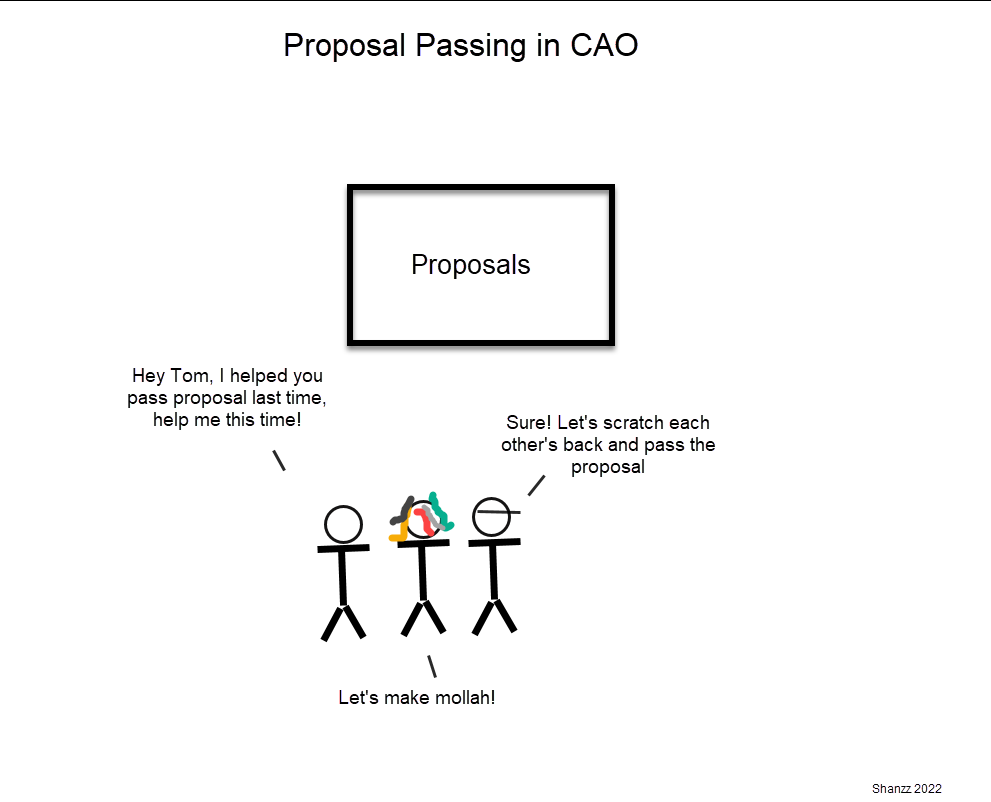
For example, I was surprised to see proposals pass, which could have been detrimental to the DAO in the long run. This was because groups reached deals to return favours to each other.
In DAOs, due to a lack of central authority, compensation and direction of the DAO are decided by the peers with the assumption that they would be unbiased and altruistic, prioritising the DAO’s overall benefit.
But in CAOs, some members have an ulterior motive that focuses on their “bottom line” that deviates from the mission of the DAO.
In the worst case, I have seen DAOs, where a group of people collude and pass each other’s proposals for their respective benefit.
Many honest members are afraid to raise their voices as their proposals would be indiscriminately shot down if they complained. While others have become passive, doing just their job, resigning the fate of DAO to “dominant” group members.
So if you are in any DAO that shows the possibility of being a CAO of more than 70% from the above points 1 to 8, then congratulations that you have discovered a CAO.
Now you must be wondering why I am congratulating you on identifying a CAO; it is because after the realisation you can do one of two things – Either leave the CAO (which most do) or Milk the Cow excuse me CAO by becoming yes man, joining the group and becoming a sycophant to members with influence and get a cushy salary like a government job. You’ll be pretty secure in your position unless you do something stupid, or the treasury runs out, or … your CAO turns into a DAO.
“Without culture, and the relative freedom it implies, society, even when perfect, is but a jungle.” by Albert Camus.
When the DAO gathers its most talented members with Prussian-style medals, titles, and medals, impeccable leadership and cutting-edge DAO tools and gets the governance and culture wrong, Moloch creeps in, and the qualified members leave en masse. It’s only a matter of time before we see the evils of groupism – scapegoats, bullying, cronyism, nepotism, and other group ills that don’t care about the long-term goals of the DAO and put their interests ahead of the DAO to metamorphose CAO slowly.
Joining a DAO is a big commitment, and it can be very time-consuming to understand the mission, rules, and governance and participate in decision-making. To save time and future effort, it is best to do early due diligence to see if your rules and values align with the majority of core contributors in the DAO. By reading this article, you can make a more informed decision about whether or not joining a DAO is the right fit for you and if you want to become part of something bigger than yourself.