

Imagine if you could show you have the information without revealing it. What would be the possible applications?
- Age Verification: Enter an age-restricted place without showing your entire identification.
- Data Protection: Protect your personal information, like your date of birth, from third parties.
- Credit Security: Prevent your information from being leaked by credit rating companies like Equifax.
- Secure Online Transactions: Confirm your identity during online purchases without revealing sensitive details like credit card numbers.
- Medical Data Privacy: Prove you have been vaccinated or have a medical condition without disclosing your full medical history.
This new technology, known as zero-knowledge proofs (ZKPs), allows for these possibilities and more.
What is ZKP?
Zero-knowledge proofs (ZKP) are cryptographic methods that enable one party (the prover) to demonstrate to another party (the verifier) that they know a value (such as a password), without conveying any information apart from the fact that they know the value. This concept was first introduced in the 1980s by researchers Shafi Goldwasser, Silvio Micali, and Charles Rackoff.
At its core, a ZKP involves three key properties:
- Completeness: If the statement is true, an honest verifier can be convinced by an honest prover.
- Zero-Knowledge: If the statement is true, the verifier learns nothing other than the fact that the statement is true.
- Soundness: If the statement is false, no dishonest prover can convince the honest verifier that it is true, except with some small probability.
Let’s dive into a simple analogy to understand how ZKPs work.
Understanding ZKPs with Alibaba and the Cave
Alibaba and the cave
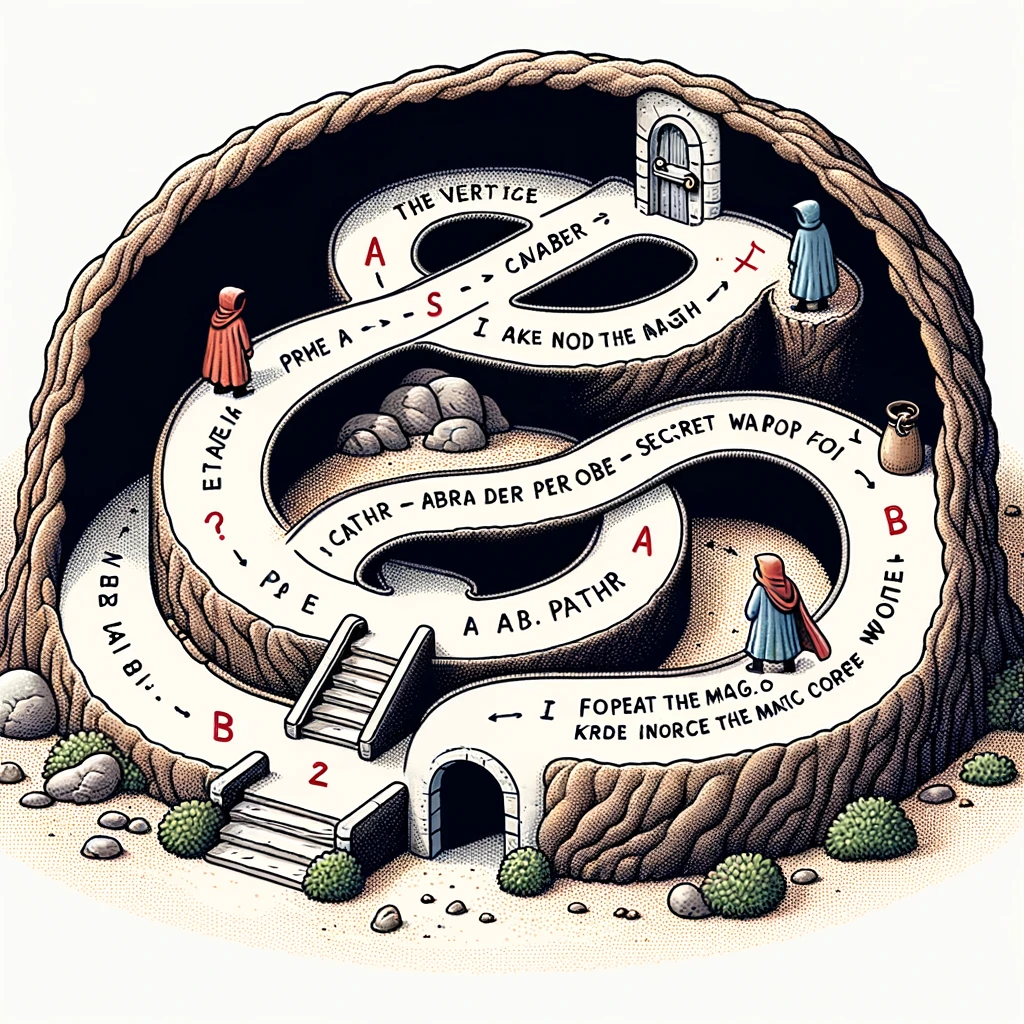
Alibaba and the Cave
Imagine a cave with a secret door that can only be opened with a magic word. You want to prove to someone that you know the magic word without actually saying it. Here’s how you could do it:
- Setup: The cave has two paths, A and B, which form a loop and meet at the secret door.
- The Challenge: You enter the cave and take either path A or B.
- The Proof: The verifier stands outside and calls out the path (A or B) that you should exit from.
- The Reveal: If you know the magic word, you can open the secret door and exit through the correct path. If not, you can’t comply with the verifier’s request.
Repeating this process multiple times ensures that the verifier is convinced you know the magic word without you ever revealing it.
Applications of Zero-Knowledge Proofs
1, Authentication Systems – Using zero-knowledge proofs (ZKPs) allows for secure authentication without traditional passwords, enhancing both security and privacy. For example, decentralized identity verification can enable users to access secure websites by proving their credentials through a ZKP-based system, thereby preventing identity theft and reducing phishing risks. In decentralized finance (DeFi) applications, users can prove they are from a specific country without sharing sensitive documents like passports or driver’s licenses, ensuring regulatory compliance while maintaining privacy. An implementation of this concept is Zupass, used during the Zuzalu experiment to verify residency without disclosing personal information.
Bank & Privacy
2, Secure Online Banking – Open banking has been a revolution in the financial services industry, transforming how consumers interact with their financial data and fostering innovation. Open banking involves banks providing third-party providers access to financial data through application programming interfaces (APIs), which offers consumers more choices and better control over their financial information. Despite these advancements, data privacy and security remain key challenges.
To address these challenges, banks have been incorporating zero-knowledge proofs (ZKPs). ZKPs enable secure, privacy-preserving authentication methods. For instance, banks can implement ZKP-based authentication systems that allow users to prove they know their account details without transmitting sensitive information like account numbers and PINs over the internet. This significantly reduces the risk of data breaches, ensuring that such sensitive information is neither transmitted nor stored on the bank’s servers.
ING’s development of the “Zero-Knowledge Range Proof” (ZKRP) is a prime example of applying ZKPs to enhance data privacy. ZKRP allows a party to prove that a value falls within a certain range without revealing the actual value. This technology can be leveraged in various banking applications to ensure compliance and confidentiality simultaneously.
Similarly, JPMorgan has integrated zk-SNARKs, a type of zero-knowledge proof, into its Quorum blockchain. This integration, derived from Zcash’s technology, allows for the privacy of transaction details, including users’ public keys and transaction amounts, while maintaining auditability for compliance purposes. By ensuring that sensitive information remains secure, this method provides a robust solution for data privacy in banking applications.
By addressing data privacy concerns and enhancing security, ZKPs can help banks navigate the complexities of open banking, ensuring secure and private financial data management.
3, Medical Data Privacy – Given the alarming statistic that 385 million patient records have been exposed in the United States between 2010 and 2022, and the increasing adoption of digital systems in healthcare, the challenge of protecting medical data is becoming more daunting. ZKPs provide a solution by allowing individuals to prove specific medical information, such as vaccination status or the presence of a medical condition, without revealing their full medical history. zPass created by Aleo is enabling users to meet necessary criteria without disclosing unnecessary details. This capability is particularly vital for the $12 trillion global healthcare industry, which serves billions of people worldwide, offering a way to address significant privacy concerns and secure sensitive medical data.

Data and Privacy
4, Credit Security – The infamous Equifax data breach in 2017 exposed the personal information of approximately private records of 147.9 million Americans along with 15.2 million British citizens and about 19,000 Canadian citizens were compromised in the breach, making it one of the largest cybercrimes related to identity theft.
ZKPs can address these vulnerabilities by allowing users to prove they meet specific credit criteria without revealing any personal information. For example, a credit applicant could use ZKPs to demonstrate that their credit score exceeds a certain threshold without disclosing the actual score or other financial details. This method ensures that sensitive data, such as Social Security numbers and credit histories, remain private and secure, significantly reducing the risk of data breaches.
In the event of a data breach, ZKPs can still protect sensitive information. Since ZKPs only confirm the validity of a claim without revealing any underlying data, even if hackers gain access to the database, they would not obtain any usable personal information. For instance, if an individual’s creditworthiness is verified through a ZKP, the proof itself does not contain any sensitive details like Social Security numbers or credit scores. This means that, even in the case of a breach, the actual personal data remains secure and inaccessible to unauthorized parties.
By implementing ZKP-based systems, credit rating companies can verify the creditworthiness of individuals without exposing their personal data to potential hackers. This technology can transform the way credit information is handled, providing a more secure and privacy-preserving approach to credit reporting and assessment.
5, Scaling Blockchain – ZK could solve the blockchain trilemma, which is the challenge of achieving three critical properties simultaneously: decentralization, security, and scalability. Traditional blockchains often have to sacrifice one of these properties to achieve the other two. This compromise limits the efficiency and effectiveness of blockchain networks.
Zero-knowledge proofs (ZKPs) offer a promising solution to the blockchain trilemma by enhancing security and privacy while supporting scalability. Compared to traditional roll-ups like Optimism and Arbitrum, which aggregate multiple transactions into a single batch for processing, ZKPs provide additional layers of security. For instance, ZKPs enable the validation of transactions without revealing underlying data, ensuring that even if data is intercepted, it remains secure and private. This method significantly reduces the risk of data breaches and unauthorized access, providing a higher level of security compared to standard roll-ups.
ZKPs also improve scalability by enabling more efficient transaction validation processes. Technologies like zk-rollups and systems such as StarkNet and zkSync leverage ZKPs to handle thousands of transactions per second. This reduces the computational load on the main blockchain, allowing it to process more transactions quickly and efficiently. Unlike traditional roll-ups, which might still expose certain vulnerabilities, ZKPs ensure that all transaction details remain confidential, providing a robust and secure scaling solution. Will expand more on this topic in the next blog post.
Conclusion
Zero-knowledge proofs (ZKPs) represent a transformative advancement in cryptography, offering robust solutions to pressing challenges in data privacy and security. From age verification and data protection to secure online banking and credit security, ZKPs enable individuals and institutions to verify information without revealing sensitive details. This technology not only mitigates the risk of data breaches, as evidenced by the notorious Equifax incident, but also enhances the privacy and security of medical data in an increasingly digital healthcare landscape.
Moreover, ZKPs address the blockchain trilemma by providing a scalable, secure, and decentralized solution that outperforms traditional roll-ups. By leveraging ZKPs, blockchain networks can achieve high transaction throughput while maintaining the confidentiality and integrity of transaction data.
As industries continue to evolve and adopt digital solutions, the implementation of ZKPs will become increasingly vital. By integrating this technology, we can build a more secure, private, and efficient digital ecosystem, paving the way for innovative applications across various sectors.
By embracing zero-knowledge proofs, we can ensure that our digital interactions remain secure, private, and efficient, fostering trust and innovation in a rapidly changing technological landscape.
*Featured picture is The Allegory of Prudence painting with inscription “EX PRAETERITO PRAESENS PRVDENTER AGIT NI FUTURA ACTIONE DETVRPET” translates to “From the experience of the past, the present acts prudently, lest it spoil future actions.”