
1, Introduction: Why This Moment Demands a New Civic Protocol
In an age marked by institutional collapse and global disillusionment, the urgent question is no longer “how do we fix the system?” but rather, what should come after it?
We are witnessing a profound breakdown of trust in centralized governance structures. From governments to global finance, centralized media to academia, the foundational institutions of modern life are faltering under the weight of complexity, opacity, and elite detachment. Citizens feel disempowered. Cities feel alienating. And governance often feels like something done to people, not with them.
At the same time, we are on the cusp of a new technological epoch. Artificial Intelligence is redefining productivity, creativity, and even cognition itself. But the economic abundance AI promises comes with a bitter edge: mass obsolescence, existential confusion, and social fragmentation. What happens when machines can outperform us at both labor and imagination? What’s left for us to do, and to be?
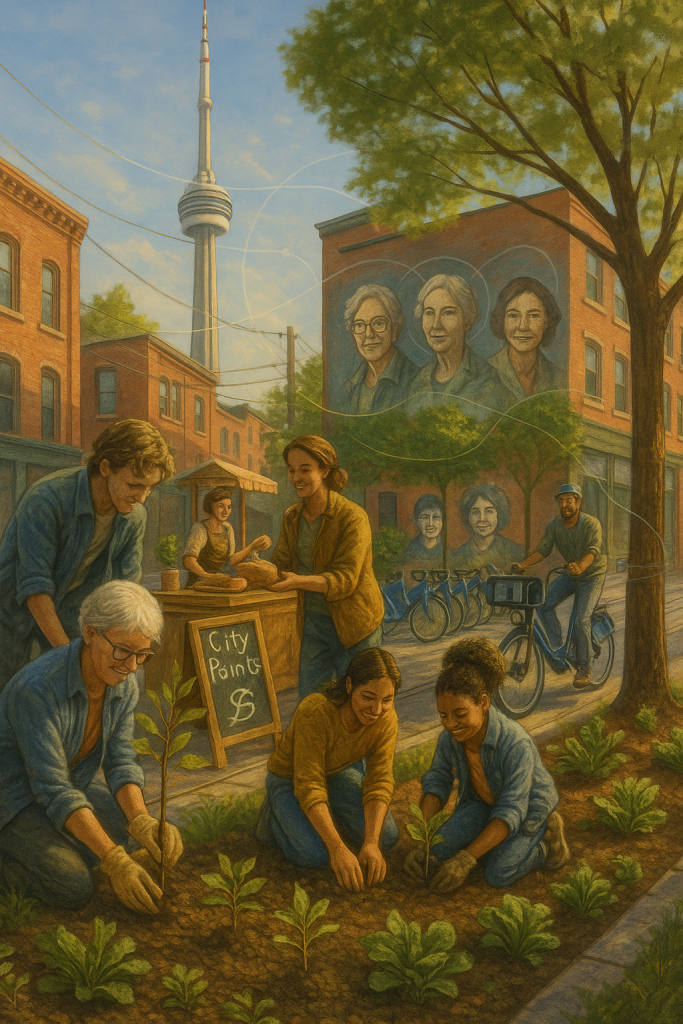
Ostromia is a civic experiment born from this very tension. It is not a startup or a product. It is a prototype of what governance could look like when everyday people contribute to shaping their own city through participation, mutual care, and collective responsibility. It draws from Elinor Ostrom’s legacy of self-governed commons, Jane Jacobs’ vision of neighborhoods as vibrant ecosystems of shared trust and culture, and Joy Kogawa’s belief in social enterprise as a connective force. It is a city that provides for everybody because it is created by everybody, sustaining a circular local economy and incentivizing contribution as the foundation of community life.
This is not just about tech. It’s about a shift in values: away from efficiency toward belonging. From scale to significance. From centralization to coordination.
Let us imagine together: a system not defined by hierarchy, but by shared purpose. A city that provides for everybody because it is created by everybody, where shared effort translates into shared abundance. A place where value circulates, not accumulates, and where participation isn’t just welcomed but essential. This is more than infrastructure. It is an invitation to reimagine and recreate society itself, starting with the neighborhood.
2. AI, Collapse, and the Need for a Civic Operating System
“Humanity is just a passing phase in the evolution of intelligence.” — Geoffrey Hinton
We are entering an age where artificial intelligence threatens not just jobs, but the very social fabric that holds cities together. While techno-utopians tout productivity gains and exponential progress, millions are grappling with the deeper cost: the erosion of meaning, agency, and place-based identity.
From gig workers to designers, from teachers to developers, no one is immune to the tidal wave of automation, synthetic creativity, and real-time optimization. The question is not just what we’ll do for work, but how we’ll live together when the work disappears.
According to the World Economic Forum, an estimated 83 million jobs will be lost to AI and automation by 2027, while only 69 million new roles are expected to emerge, creating a net loss of 14 million jobs. This is not just an economic disruption. It is a transformation of society itself.
Ostromia is a counter-offer to this unraveling. It proposes not just a patch or a policy but a civic architecture where people regain meaning and belonging. It helps communities absorb the shocks of AI by re-anchoring life around neighborhoods, stewardship of shared resources, and participatory governance. Instead of global systems optimized for extraction, it favors local systems designed for resilience. It moves us from globalism to localism, from outsourcing to insourcing, from extractive scale to regenerative proximity.
This isn’t about turning our backs on technology. It is about reclaiming its purpose. In Ostromia, technology becomes a tool for strengthening bonds rather than severing them. Ostromia does more than distribute resources—it cultivates ownership, accountability, and hope. It reweaves the fabric of community, turning every act of participation into an act of repair. If AI is the great unraveler, Ostromia is the weaver we need.
3. Founding Inspirations: Three Civic Architects
“There is no reason to believe that bureaucrats and politicians, no matter how well-meaning, are better at solving problems than the people on the spot, who have the strongest incentive to get the solution right.“ — Elinor Ostrom

Elinor Ostrom, the first woman to win the Nobel Prize in Economic Sciences for her work on the governance of commons, shattered the myth that only markets or governments can manage shared resources. Through decades of fieldwork, she demonstrated that communities can self-govern the commons through trust, rules, and localized cooperation. Her eight principles for managing shared resources offer a blueprint not only for forests or fisheries, but for cities themselves.
“Cities have the capability of providing something for everybody, only because, and only when, they are created by everybody.“ — Jane Jacobs

Jane Jacobs understood cities not as machines but as living organisms, complex, unpredictable, and deeply human. She championed walkable streets, mixed-use neighborhoods, and bottom-up planning. For Jacobs, vibrant cities emerged not from top-down plans but from the slow choreography of daily life, the sidewalk ballet.
“A social currency can be more than money. It can be a mirror of our values, a way to connect, to uplift, to belong.“ — Joy Kogawa

Joy Kogawa, through her pioneering work on the Toronto Dollar, reminded us that money itself can be reimagined as a tool for solidarity. Her vision of a social currency rooted in community values, rather than profit extraction, laid the emotional groundwork for a circular, local economy that rewards care and generosity.
Together, these women offer more than historical inspiration. They offer living blueprints. Ostromia is their intersection—the commons governed by trust, the neighborhood as the heartbeat of the city, and the economy as an extension of our collective care.
Let their legacies be the roots. Let our collaboration be the canopy
4. How Ostromia Works: A Blueprint for Local Participation
Ostromia is built on a simple premise: people are more likely to care for what they help create. Its structure is designed to make participation not just possible, but rewarding. At its core is a local incentive model that recognizes and uplifts everyday contributions to the community. Whether someone organizes a neighborhood cleanup, volunteers at a local garden, shares resources with a nearby school, or mentors a young person, these actions are acknowledged and rewarded through a system of community credits known as City Points.
These points are not abstract tokens. They represent real participation and can be redeemed for meaningful local value, such as discounts at neighborhood stores, access to events, or even voting weight in deciding which public initiatives to support. But what if these points weren’t limited to a single type of action or closed ecosystem? What if recycling during rush hour, sorting waste properly, volunteering at a shelter, or mentoring youth all earned recognition through the same civic ledger, and Ostromia was the place that made sense of it all?
Take, for example, city bike systems. During rush hours, bikes are often unavailable at high-demand stations. Ostromia could incentivize users to return cycles to less popular, underused areas by rewarding them with points, turning inconvenience into cooperation. Similarly, local purchases from small businesses could earn extra points, reinforcing a neighborhood-first economy. Helping nonprofits, assisting seniors, or donating time and talent would all be captured as valuable civic actions.
Ostromia acts as the connective tissue for these decentralized contributions. It aggregates, translates, and redistributes the value of loyalty points across a spectrum of actions. In doing so, it becomes more than an incentive system; it becomes a civic operating system for mutual benefit, helping to harmonize local economies and honor acts of everyday care.
Participation is open to all. Residents, nonprofits, small businesses, and local institutions can contribute to and benefit from this ecosystem. The platform is intuitive, accessible, and deeply localized, customized to reflect the values, goals, and needs of each community it serves.
In Ostromia, engagement is not an afterthought. It is the foundation, and more than that, it is a catalyst. As a civic operating system, Ostromia connects otherwise isolated actions and amplifies their collective value. It enables cooperation, improves local connectivity, and nurtures a deeper sense of community. By aligning individual contributions with shared rewards, it turns civic participation into a regenerative loop of trust, visibility, and value.
5. Rethinking Value: City Points as Civic Currency
At the heart of Ostromia’s model is a new kind of currency, one rooted not in profit, but in participation. City Points function as a civic ledger that tracks and honors meaningful action. Unlike traditional currencies, these points are not extracted from labor for private gain, but generated through collective benefit. They are earned by acts that strengthen the commons and redeemed in ways that reinforce local reciprocity.
This civic currency opens up possibilities far beyond simple discounts. It can be used to vote on community priorities, gain access to shared spaces, or unlock services provided by public or nonprofit partners. It becomes a medium of local coordination, linking efforts that might otherwise remain invisible or undervalued. By weaving together diverse contributions, from urban farming to youth mentorship to neighborhood organizing, City Points create a shared narrative of contribution and care.
To ensure these incentive mechanisms are effective and fair, Ostromia draws on principles from the emerging field of token engineering. One such tool is the bonding curve, a dynamic pricing model where the cost of creating new tokens (or points) increases as supply grows. This allows the value of participation to evolve with engagement, balancing supply with meaningful contribution. Time-locked rewards and redemption pathways tied to social goods help avoid short-term exploitation and reinforce long-term community health.
Before implementation, models like these can be tested using cadCAD, a powerful simulation framework that helps anticipate unintended consequences and optimize incentive design. This approach ensures that Ostromia’s system works not just in theory, but in practice.
City Points themselves may be differentiated, some functioning more like governance tokens with voting power, while others operate like loyalty points earned through service. Balancing access, influence, and trustworthiness becomes a design choice, shaped by the community’s unique context.
In this system, value is not dictated from above but emerges from the ground up. The more a neighborhood participates, the richer the ecosystem becomes, not just in material wealth, but in trust, connection, and mutual support. In Ostromia, value is not hoarded. It is circulated. And it always points back to the place it came from.
6. The Vision: Civic Resilience at Scale
Ostromia is more than a platform or a toolkit. It is a civic movement, a cultural shift that invites people to rediscover the power of collective agency. At a time when social bonds are fraying and institutional legitimacy is in crisis, Ostromia offers a grounded alternative: rebuilding the commons from the neighborhood up.
But the vision does not end at the neighborhood. What if every city had its own Ostromia module? Imagine a network of civic operating systems—interoperable, regenerative, and transparent—woven into the fabric of cities around the world. These systems would act as adaptive infrastructure for civic participation, enabling communities to engineer shared value through local incentive loops.
By weaving participation, recognition, and reward into daily life, Ostromia doesn’t just support local infrastructure. It strengthens the social muscle memory of cooperation. It encourages residents to see one another not as strangers or competitors, but as co-stewards of a shared place. This is not an app for civic engagement; it is a foundation for civic resilience.
In moments of crisis—whether economic, ecological, or political—resilient communities respond faster and recover stronger. Ostromia helps build that resilience not through central command, but through local coordination. It transforms small actions into systemic impact, creating a network of care and cooperation that adapts, persists, and grows stronger with each interaction.
Ultimately, Ostromia is not only about making better cities. It is about making better citizens—empowered, connected, and rooted in the belief that democracy is not something we inherit, but something we practice together.
7. Next Steps and Invitation to Collaborate
Ostromia is an evolving experiment, and its next phase depends on the imagination and commitment of collaborators across disciplines. To bring this civic operating system to life, we are calling on token engineers, bonding curve designers, community organizers, and system thinkers who share a passion for building resilient local economies.
We will be publishing a GitHub repository containing bonding curve models, cadCAD simulation scripts, and open governance templates that others can adapt and improve. This foundational toolkit is intended to be forked, remixed, and piloted in diverse community contexts.
Cities, neighborhoods, collectives, and institutions are invited to join the movement—test the model, localize it, challenge it, and contribute to its evolution. We believe that Devconnect and similar gatherings are ideal spaces for dialogue, iteration, and co-creation.
The door is open. The invitation is active.
8. Conclusion: Let’s Engineer the Next Layer of Civilization
This is not about “tech for good.” It is about tech for governance, dignity, and distributed stewardship. It is about engineering systems that support life—not just infrastructure, but interdependence.
Commons are not a nostalgic idea. They are the infrastructure of the future: programmable, adaptive, and deeply relational. In Ostromia, shared value is not a slogan but a design principle. It is engineered through local incentive loops, reinforced through participation, and distributed through care.
Ostromia is a civic operating system for cities—interoperable, regenerative, transparent. And it is an OS for something even deeper: for belonging, for cooperation, for a new kind of public imagination.
Ostromia is not a tool. It is a turning point. A new layer of civilization, built not through extraction or centralization, but through contribution, connection, and shared stewardship.
Let’s build it—together.
Update -20 June 25 – First version of Ostromia using bonding curve has been released https://github.com/shanzzenith/Ostromia-civic-os
If you want to take part join the telegram