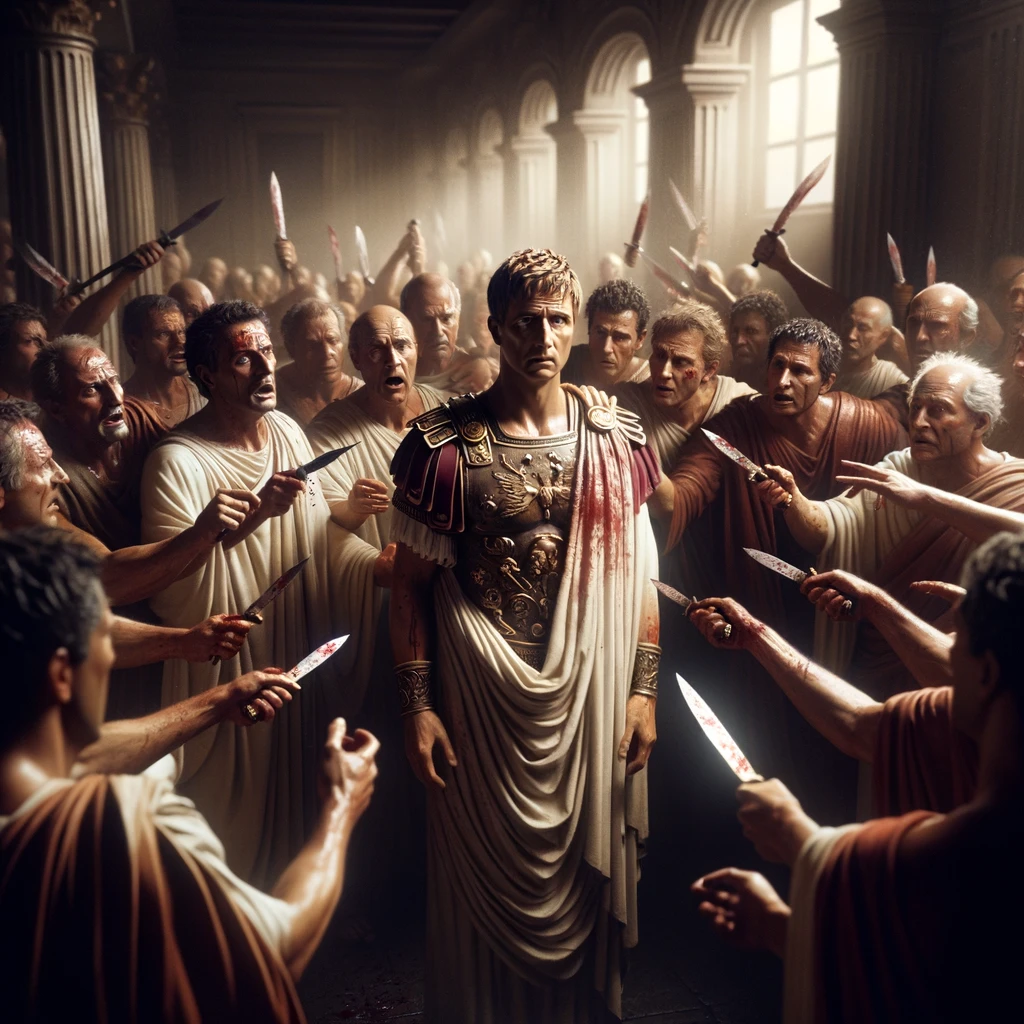

Et tu Brutus? –Julius Caesar (William Shakespeare)
Were the last despairing words Caesar apparently uttered as he lay dead stabbed 23 times by the conspiring senators. Julius Caesar was one of the most dashing military general and consul Rome ever had, his charisma and victories won him fame and popularity amongst the masses, gained wealth and was gaining so much influence to overcome and rewrite the rules of republic to become monarch which the senators despised which will lead to death of Republic. His accumulating wealth, influence, and potential to transform the Roman Republic’s governance incited fear and resentment among the senators as they feared he would transform into a monarchy. They viewed his ascent as a direct threat to the Republic’s survival, leading them to plot his tragic end.
The Coup
As I was writing this sentence, OpenAI experienced a temporary service disruption. Recently, Sam Altman was ousted as CEO by the board of OpenAI, although specific reasons weren’t publicly disclosed. OpenAI, initiated by Sam Altman, Elon Musk, Greg Brockman, Ilya Sutskever, Wojciech Zaremba, and John Schulman, was established in 2015 originally as a non-profit with the goal of developing artificial general intelligence (AGI) to benefit ‘humanity as a whole.’ Overtime it changed from non-profit to for-profit as Elon who promised to finance left the company and they needed cash to train the model. There were two factions inside the camp – one that was strongly pro commercialization and other Ilya Sutskever who was cautious and understood the dangers of AI.
The Smoke
“As my colleague Karen Hao and I reported over the weekend, the central tension coursing through OpenAI in the past year was whether the company should commercialize, raise money, and grow to further its ambitions of building an artificial general intelligence—a technology so powerful that it could outperform humans in most tasks—or whether it ought to focus its efforts on the safety of its potentially dangerous innovations. Altman represented the former faction, and his aggressive business decisions appear to have been a key factor in his dismissal.” – Charlie Warzel
The Atlantic reported that Altman’s eagerness to rapidly release new products and models, prioritizing speed over safety, caused friction with the board. Additionally, it’s been suggested that Altman’s external fundraising activities, reportedly involving discussions with a wide range of parties including Jony Ive, potential NVIDIA rivals, and investors from surveillance-oriented autocratic regimes in the Middle East, contributed to the board’s decision to intervene.
The world of two Brutuses
“Sutskever took on the role of Brutus, informing Altman that he was being fired. Half an hour later, Altman’s ouster was announced in terms so vague that for a few hours, anything from a sex scandal to a massive embezzlement scheme seemed possible.” – Ross Andersen
Reflecting on my high school history lessons, I recall there was the mention of only one Brutus in the assassination of Julius Caesar. Contrary to popular belief, there were actually two individuals named Brutus. Marcus Junius Brutus, often viewed as the son of Caesar’s mistress, was an idealist deeply committed to the Republic’s principles. In contrast, his cousin Decimus Junius Brutus, was a chosen Caesar’s heir (unknown to him), betrayed him, possibly motivated by a desire for power.
In considering Ilya Sutskever’s role at OpenAI, one might draw parallels to these historical figures. Is Sutskever akin to Marcus Junius Brutus, acting out of principled concern for AI safety and the greater good, akin to protecting the Republic? Or does his role resemble that of Decimus, potentially driven by personal ambition and the quest for power within the organization?
“The rapid progress of OpenAI’s large language models had made Sutskever more confident that AGI would arrive soon and thus more focused on preventing its possible dangers, according to Geoffrey Hinton, an AI pioneer who served as Sutskever’s doctoral adviser at the University of Toronto and has remained close with him over the years.” – Karen Ho
Ilya Sutskever might have underestimated Sam Altman’s popularity, in a way reminiscent of how the senators underestimated Julius Caesar’s enduring influence. n contrast to Caesar, who never saw the Republic’s transformation into an empire, Sutskever is in a position to observe the aftermath of his own actions, as Altman not only regained his position but also strengthened his control, diminishing the influence of the faction advocating for greater AI safety. This turn of events mirrors the ancient Roman narrative, where the initiators of change, akin to OpenAI’s early founders, resisted the idea of centralized powerful authority, be it a tyrant or a tech giant.