
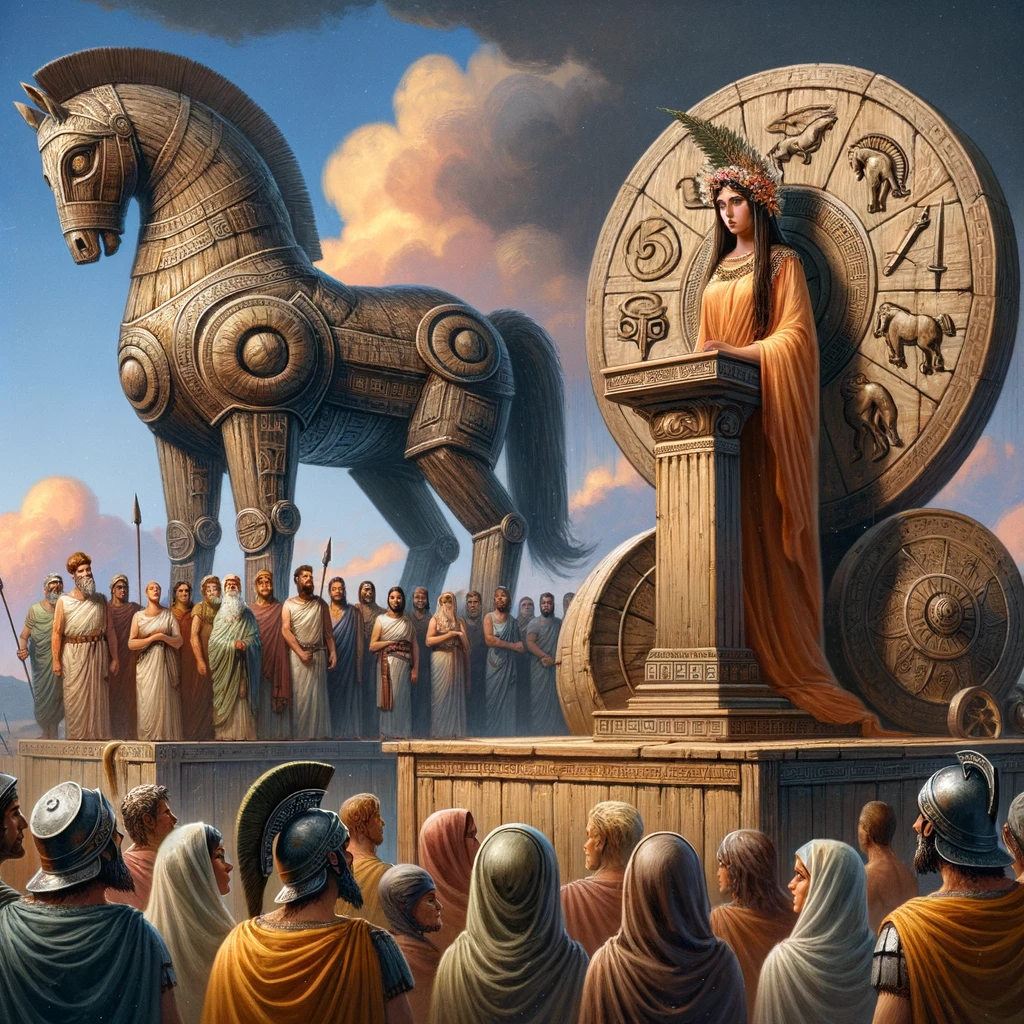
Cassandra: “Citizens of Troy, heed my words! Though I am cursed and my truths are oft ignored, I implore you to listen now. There lies danger in the Greeks’ wooden beast. It is no gift—it is a harbinger of our demise!”
Fictionalized dialogue in Illaid
People of Troy: “Poor Cassandra, Apollo’s curse weighs heavy upon her. Pay her no mind.”
Cassandra was a princess of Troy, who was granted the gift of prophecy by Apollo, the god of truth and prophecy, among other things. However, when Cassandra spurned Apollo’s romantic advances, he placed a curse on her, ensuring that while she could see the future and have the knowledge but no one would ever believe her. Cassandra’s story reflects the curse of knowledge in a tragic and mythical light. Her tale illustrates the potential isolation and despair that can accompany the inability to communicate crucial knowledge to others.
I have recently seen many tech teams suffer from what I call “Cassandra Complex“.
Recently at an event, I met a tech team working on a crypto AI project. Initially, their explanations via white papers and videos left me confused. However, after meeting four other team members and spending additional time, I summarized their start-up as the “Shopify of AI compute?” which the CTO quipped “That is a beautiful way to put it“.
Here is another example that elaborates on “Curse of Knowledge” and how are things explained by tech people.
Imagine someone explaining what a car is to somebody in 1889 who is unfamiliar with what a car is.
Explanation A
“A car, a self-propelled vehicle, relies on an internal combustion engine to convert fuel into mechanical energy, propelling it. The engine ignites fuel, generating energy that drives pistons within cylinders. Spark plugs initiate fuel ignition, and along with pistons and other components, facilitate the conversion of fuel into mechanical power for car movement……..“
Explanation B
“Did you know 2000 people died due to horse falls this year? Cars, powered by internal combustion engines, offer a safer, more reliable transportation alternative. They travel faster, cover longer distances quicker, and have higher carrying capacities. Unlike horses, cars don’t require extensive care, saving time and resources. They represent a huge leap forward from relying on horse-driven conveyances.”
Explanation A deals with the”How” while B explains “Why” & “What”
Most tech teams start with “How” ie How their technology is made with the assumption the listener knows the background that is why during tech meeting many phase out after 3 minutes.
Get people interested the the “Why” is this technology important? (horse deaths above), “What” problems are it solving for me? Then if they are interested move to “How”.
People these days have the attention span of goldfish. It suggests a need for communicators, especially in tech, to quickly engage their audience amid a sea of information, ensuring their key messages are easily understood and remembered.
The article points out a common problem in tech talks—the “Cassandra Complex.” Tech experts love explaining “How” their stuff works but forget to tell “Why” it’s important or “What” problems it solves. This makes their talks confusing. By explaining the “Why” and “What” first, tech teams can connect better with their audience, making sure their cool ideas are both clear and valued by others. This way, more people can understand and get excited about new tech advancements by using Feynman technique.